
THE PROJECT BACKSTORY AND SEARCH FOR INFO
After completing my first video on Allan Travers, the Catholic priest who pitched against the Tigers in 1912, I was looking for another fun story to make a video on. I scoured the internet for any unique and somewhat unpopular sports stories, and decided Charlie Finley was the subject I was looking for. So I started reading anything on Charlie that I could find online as well as a book I ordered. His antics include moving the outfield fence, having live animals as mascots, and using a mechanical rabbit to deliver rabbits to umpires. All great stuff. Similar to my first video, I wanted to set the scene in a ballpark, and the home park of the Charlie Finley Athletics (before moving to Oakland) was Kansas City Municipal Stadium. In my first video I had spent some time on the façade and scoreboard of Shibe Park and made the dimensions of the field correct, but I didn’t go into finer details as I didn’t think it was necessary for the video. I didn’t really plan on going into finer details with this stadium either…
But as I started researching the park and modeling the basic dimensions I realized there was only so much available details and readily available images. This, of course, made it much harder to get things correctly to scale. And the search for a seating chart… well that was a process. The mystery of these things made me curious and even more determined to find all the details I possibly could. The park went through a number of changes over the years, like adding seats down the left field line and behind the right field wall, changing outfield wall distance and heights, extension of the press box, different color paint, etc. I was set out to build a mid 60’s version of the park, before the A’s moved and around the time Charlie Finley was doing his Pennant Porch gimmick. So not only did I have to find info on the stadium, but I had to decipher whether or not the pictures or measurements were from the same year I was working on.
To start modeling, I used Andrew Clem’s website to make the footprint of the stadium. As helpful as the diagram was, it didn’t provide me with all the information I was going to need. I started looking at every photo that popped up when I searched “Kansas City Municipal Stadium” in Google, and Getty Images, and the Kansas City Public Library. I watched some YouTube videos and was able to gain some information, such as roof height and outfield light height, thanks to this podcast. With these resources and some educated guessing, my structure was looking like it actually resembled the stadium!

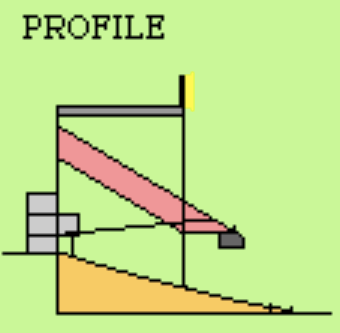
But I was going to need some finer details (angle of the stands, dimensions of individual seats, and of course a seating chart to know how many seats per row and section). I ended up using Clem’s side profile diagram to estimate the angle of the stands (upper deck was 31°). Plus I had read about the angle of some stadiums, so I knew the Clem’s diagram was similar enough to be close to correct.
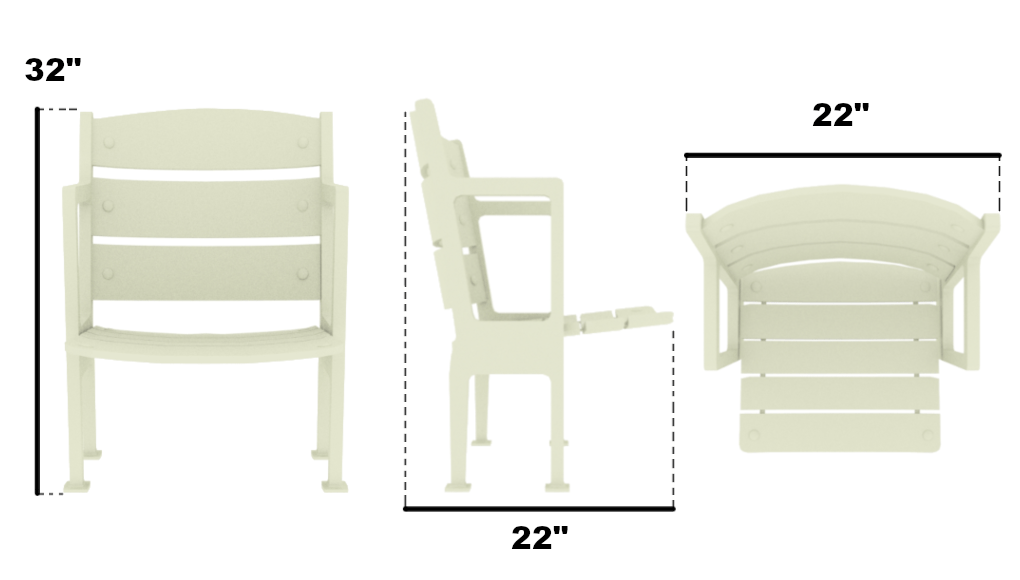
In terms of the individual seats, I ended up on some very informative websites (some good stuff on sightlines and angles here) of companies who make stadium seats, an article about different MLB teams and their seat sizes, and even found some actual KC Municipal Stadium seats in some personal collections, and on auction sites. I used some of these images to start my seat model, but in order to make this as accurate as possible I really wanted to know the dimensions. So I got in touch with Jeff Logan of Crown Sports Auctions and he not only gave me the dimensions I needed but also some fun stories and pointed me in the direction of some photos he had of the stadium. Thanks Jeff!
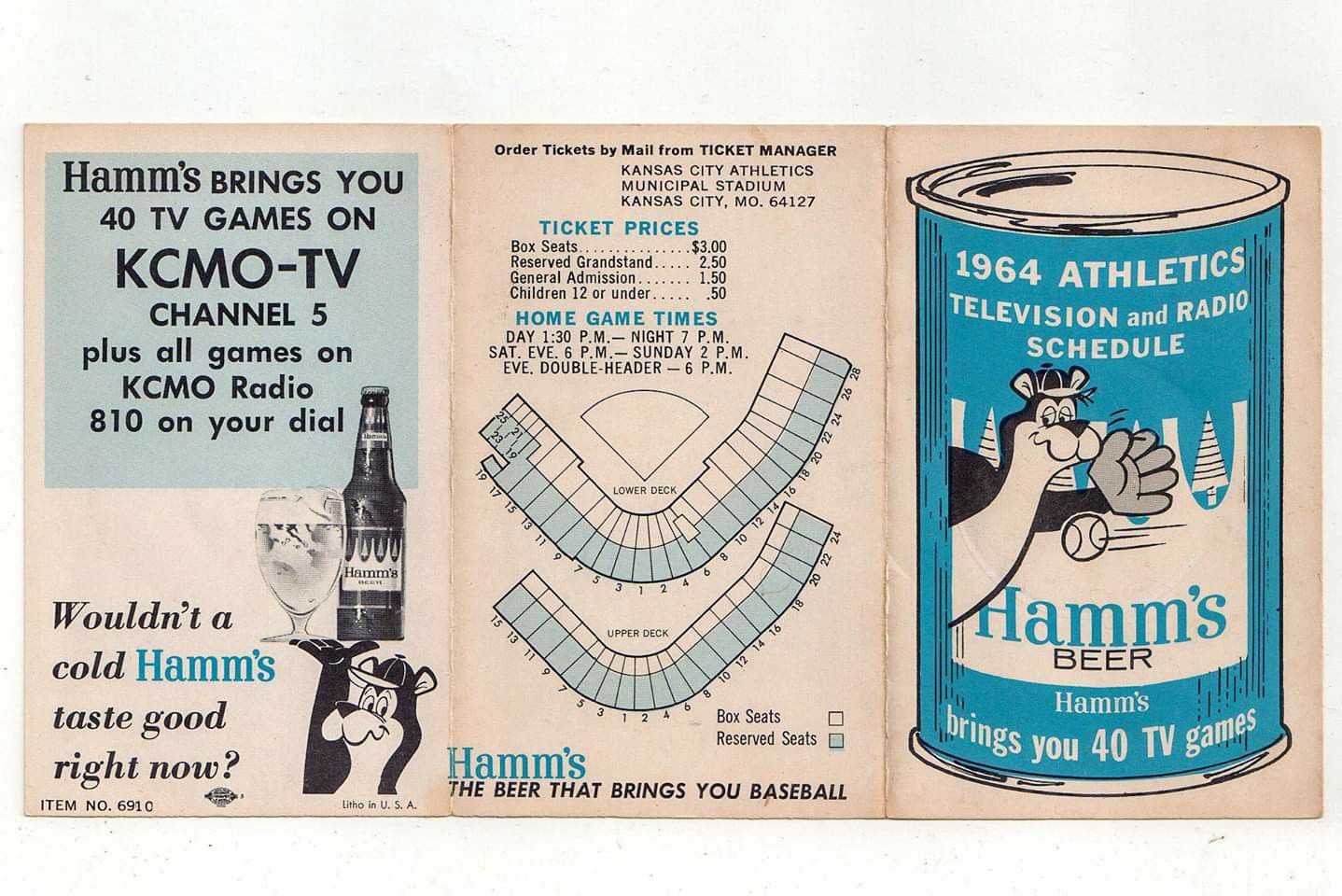
With a seat completed, I started building rows and could start importing them into my stadium. However, I still didn’t have all the correct numbers of seats per section/row, so my search for a seating chart continued and I started contacting more people. My first email was to someone at Osborn Engineering, the people who had originally built the stadium in 1923. They didn’t answer. I later found out the 1955 renovation was done by someone else, so even if they had some blueprints it probably would have been different than what I was looking for. I contacted some folks at SABR, and Ron Selter and Kevin Johnson of the SABR ballpark committee sent me over everything they had on the stadium. Some great info, but nothing in terms of a seating chart. I contacted some museums and even sent something to the Royals, who used the stadium for 4 seasons after the A’s left and before Kauffman Stadium was built. Not more than a few hours after my email to someone at the Royals I got a lengthy response from Curt Nelson, Director of the Royals Hall of Fame. Like Ron and Kevin, Curt was excited about my project. He pointed me in the direction of some museums, and mentioned the Royals had been in talks with Populous about a KC Municipal Stadium model but it never came to fruition. Along with some info and further places to research, Curt sent me this awesome seating chart from the first meeting of the Royal Lancers, a group of businessmen who formed the Royals first season ticket sales force. The seating chart still says “Athletics” by the dugouts while the handwritten header says “Royals”. This, and a few other similar seating charts I had found helped me figure out how many sections and rows there were and the numbers of each of those sections. Still, no one seemed to have a chart complete with individual seats.

The night before I was in touch with Curt, I found and joined a Facebook group called ‘Kansas City Municipal Stadium Tribute Page.’ I spent roughly 2 hours looking at every image that has been posted on the page over the past 7 years… and some of those images were awesome and very helpful! The next day I posted on the page with a render of my progress and a hand drawn seating chart I was working on. I was mostly posting to see if anyone could help me out with the information I was seeking, but I also got some great feedback from people who were eager to see my progress and final product. Amongst the supportive comments were a couple comments that gave me some missing information. The first mentioned a book (Dope Baseball) that Sporting News put out yearly in the 60s and 70s. I was told they always included stadium diagrams along with stats and stories. So I found a few copies, and a few different years of the book online, and ended up buying a 1966 copy. The book is awesome! But the stadium diagram provided me with no more information than I already had.


Nearly two weeks after my post, another person commented saying Coach’s Bar in Overland Park Kansas City has an architectural drawing of the 1955 rebuild in its bar area… This is great. If only I lived in Kansas City. An 8 hour drive to the bar might be worth it, but first I figured I’d email them to see if they could send me a picture or had information on where I could get my hands or just eyes on a version of the drawing. A week went by and then came some information I had been looking for for almost a month now! A SEATING CHART SHOWING INDIVIDUAL SEATS.
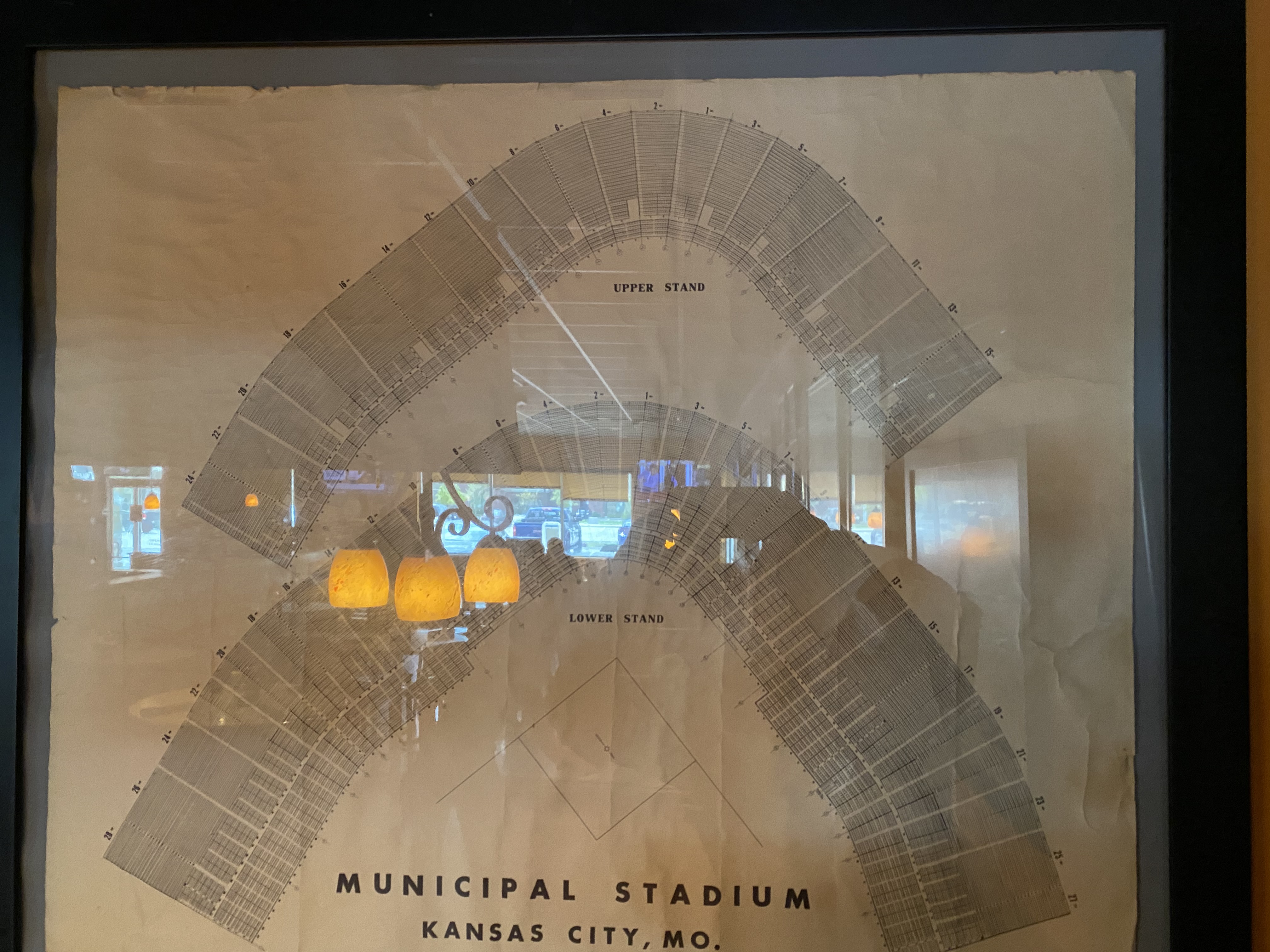
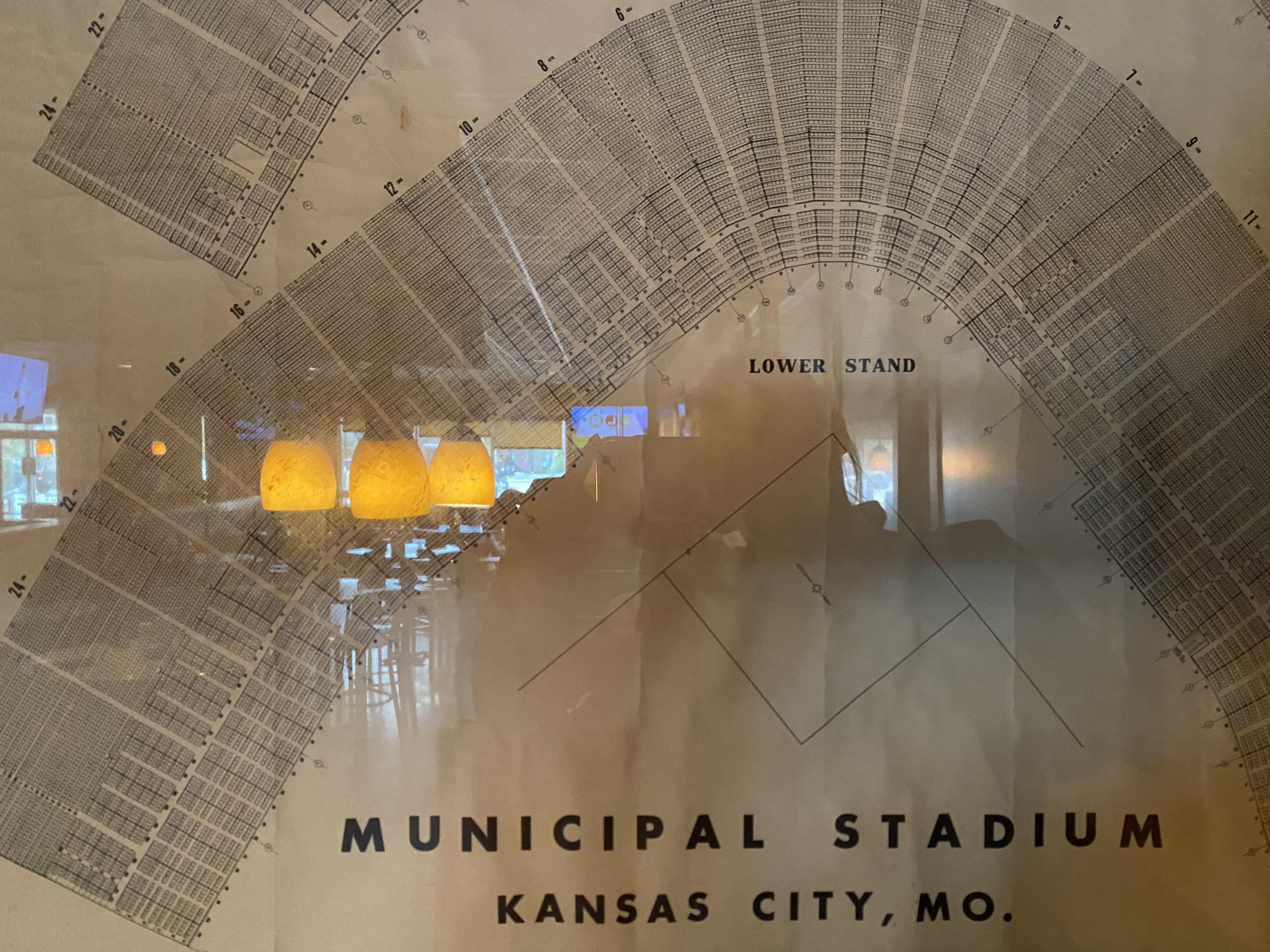
I used this to confirm the numbers I had, and to fill in the blanks on my chart. Big shout out to Spencer at Coach’s for taking the time to get some pictures and email them over to me.
Now that I had a nearly complete seating chart I had to overlay that with Clem’s diagram that I had been working with. Some of the angles didn’t line up exactly but I figured it out.

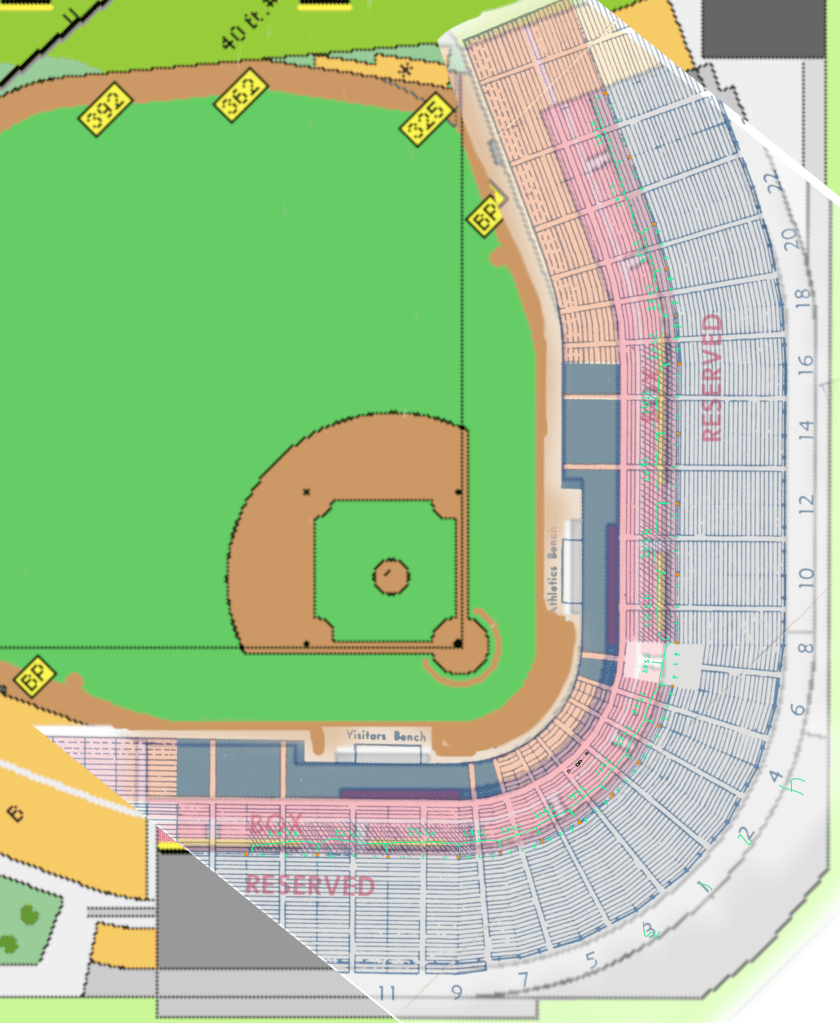
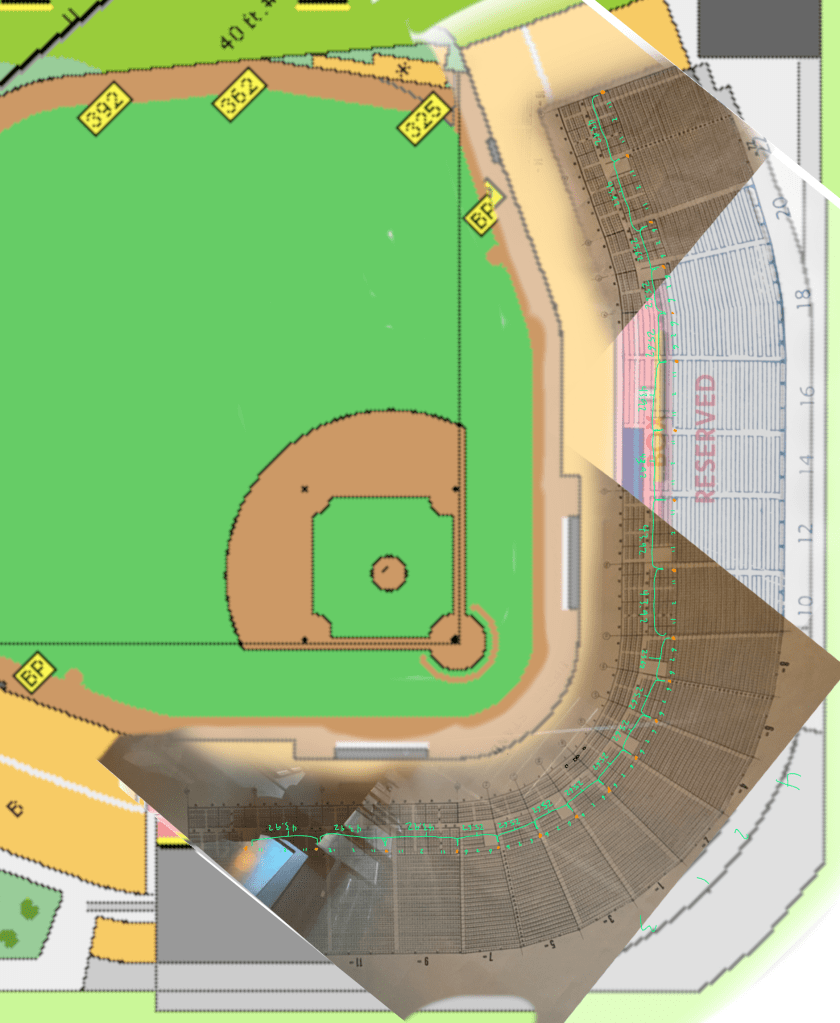
After lining them up I ended up redoing a lot of the work I had previously done… I fixed up angles, moved the poles the correct distances from each other, and plotted out the sections. I built the rest of the stands and I placed rows of seats and copied seats and placed more rows of seats and copied seats and…. Well here is what the stands of my model looked like after I got the chart I needed. If not perfectly accurate, quite close.
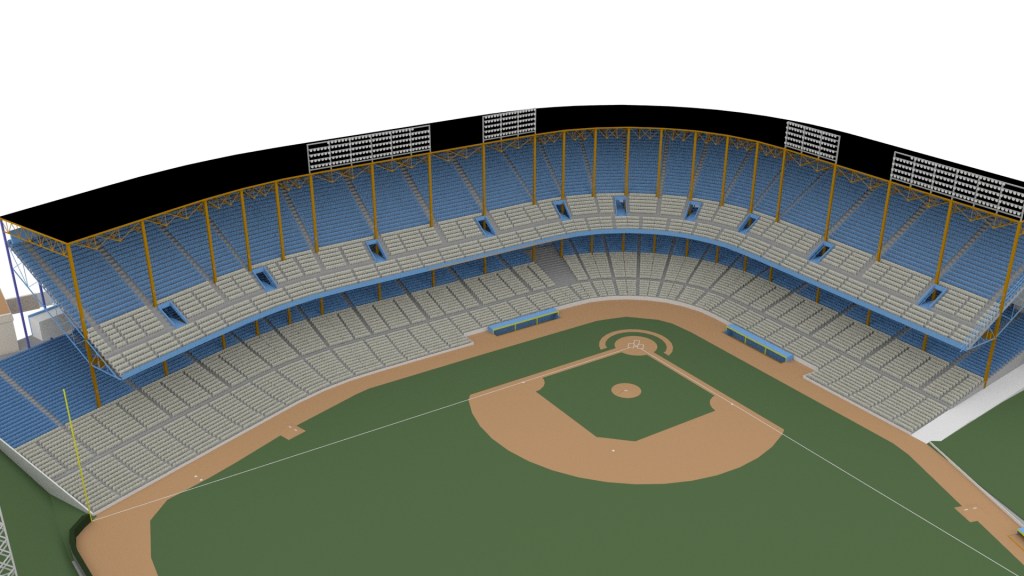
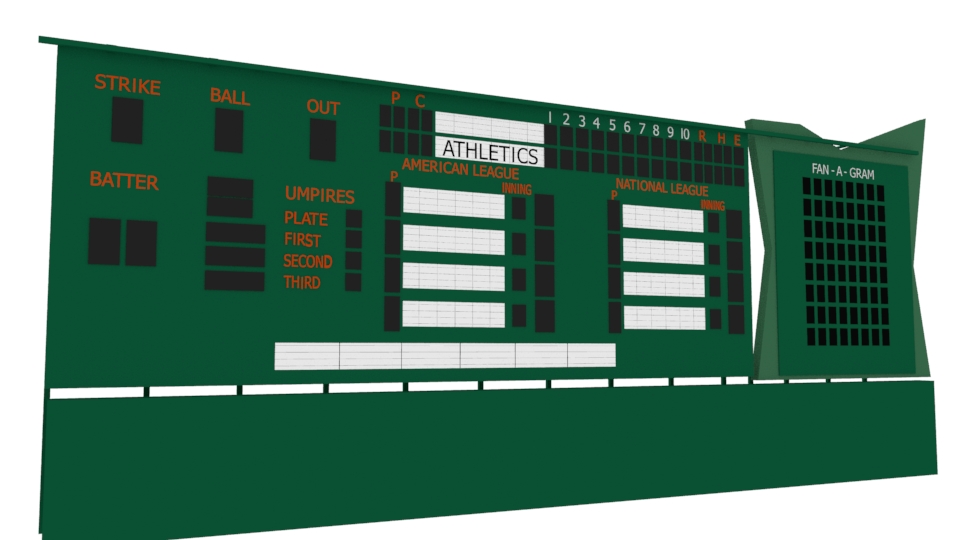
The stands are a big part of the stadium, but certainly not the only important aspect. Another important and distinct thing is the centerfield scoreboard. The scoreboard resided in KC Municipal Stadium from the 1955 reconstruction through the 1976 demolition. Before moving to Kansas City it was at Braves Field in Boston, and like other parts of the stadium it had some changes over the years. These changes include additions to the paneling on the left to accommodate putting up football scores for Chiefs games, and an extension to the right of the board which housed the Fan-A-Gram or Fan-R-Gram.
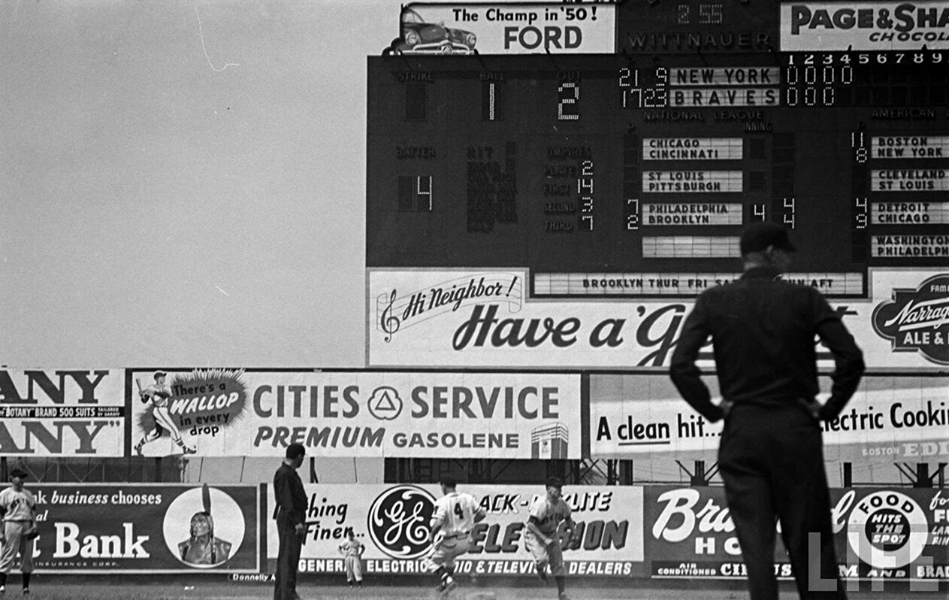
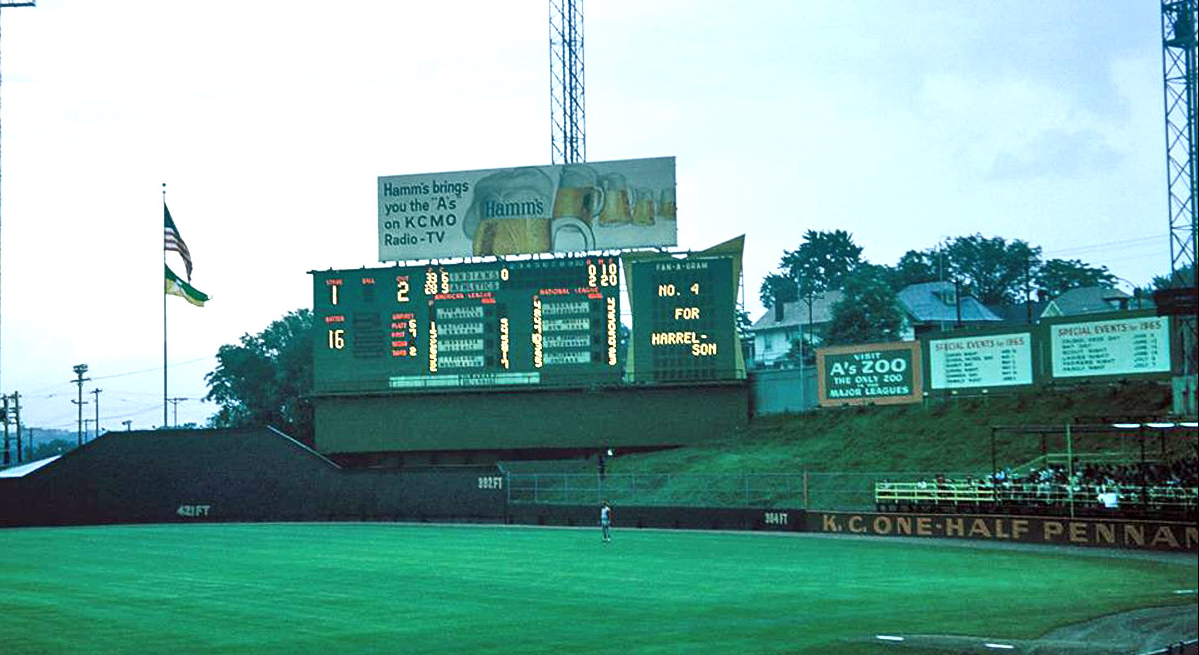

Again, I didn’t find exact dimensions on the board but using images from numerous angles, and comparing it to dimensions of other parts of my model it seems to have been somewhere around 118 feet long (with Fan-A-Gram extension) and 32 feet tall.
The field itself was set below ground level. Which provides kind of a cool look, but makes my life a bit harder. The corner of 22nd and Brooklyn (Right field line where the building is) is quite a bit higher in elevation than 21st and Brooklyn (beyond centerfield).
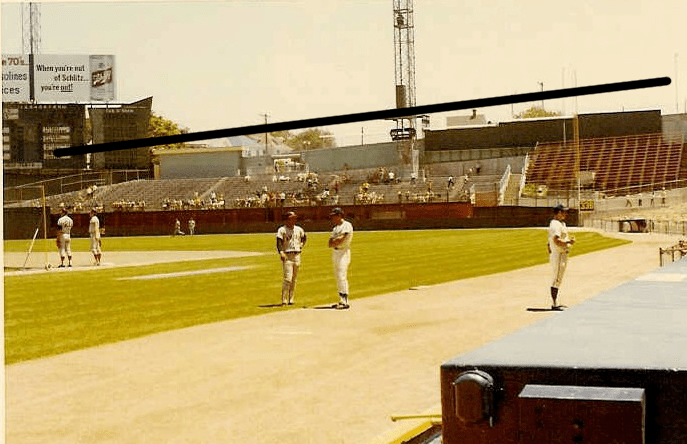
According to Andrew Clem the rear of the lower deck in the right field corner was at street level, whereas on the third base side it was 10-20 feet above street level. Again, I did my best to make approximations and get things close to the images I have looked at.
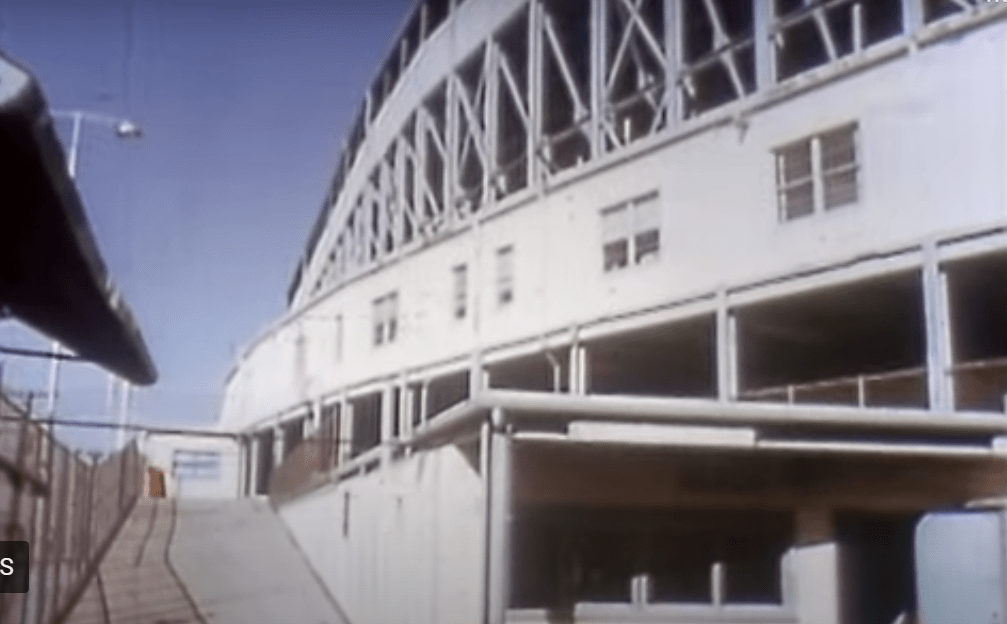
Lastly, I didn’t find many pictures of the outside of the stadium behind home plate. Of course that part is much less important than the playing field, stands, and scoreboard, but still essential to the look of the stadium. I modeled the outside by piecing together images like these:


For a full gallery of my Kansas City Municipal Stadium Renders click here
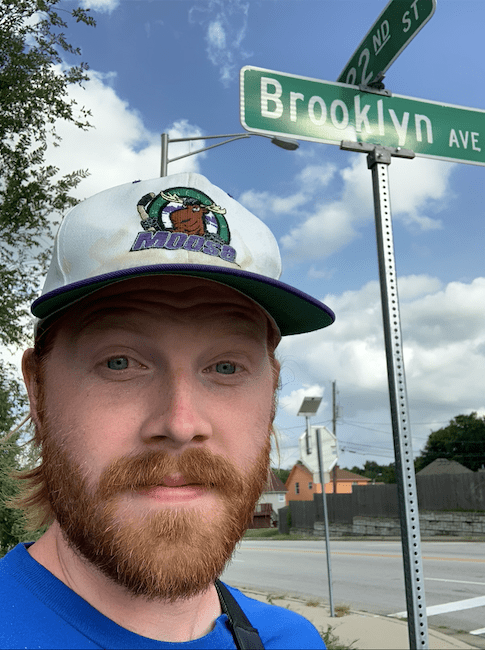
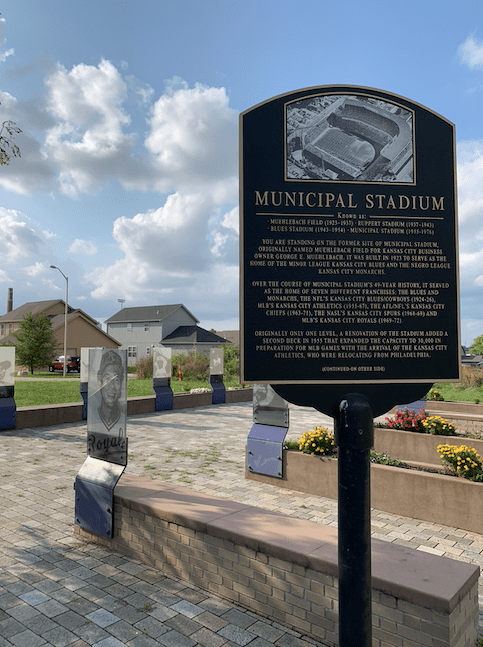
September 2021: I made a visit to the corner of 22nd and Brooklyn!
UPDATE: In August of 2023, KC sports architect David Folsom came across my work and reached out. We worked together (I gave him the files and he worked magic) on making it bigger and better. 6 months later David has given new life to my project and captured the beautiful parts of an old ballpark: https://dfolsomarcht.com/old-downtown-ballpark/
 EBart
EBart 